Paper Trading for Beginners: Practice Before Risking Real Money
Paper trading for beginners is one of the smartest ways to learn how trading works before risking real money. Instead of jumping into the market with real funds, paper trading allows you to practice entries, exits, risk management, and decision-making in a simulated trading environment.
This page is for educational purposes only. It is not financial advice, a trading recommendation, or a promise of results. Trading stocks, futures, options, forex, and other financial markets involves risk. Beginners should take their time, practice responsibly, and understand the risks before using real money.
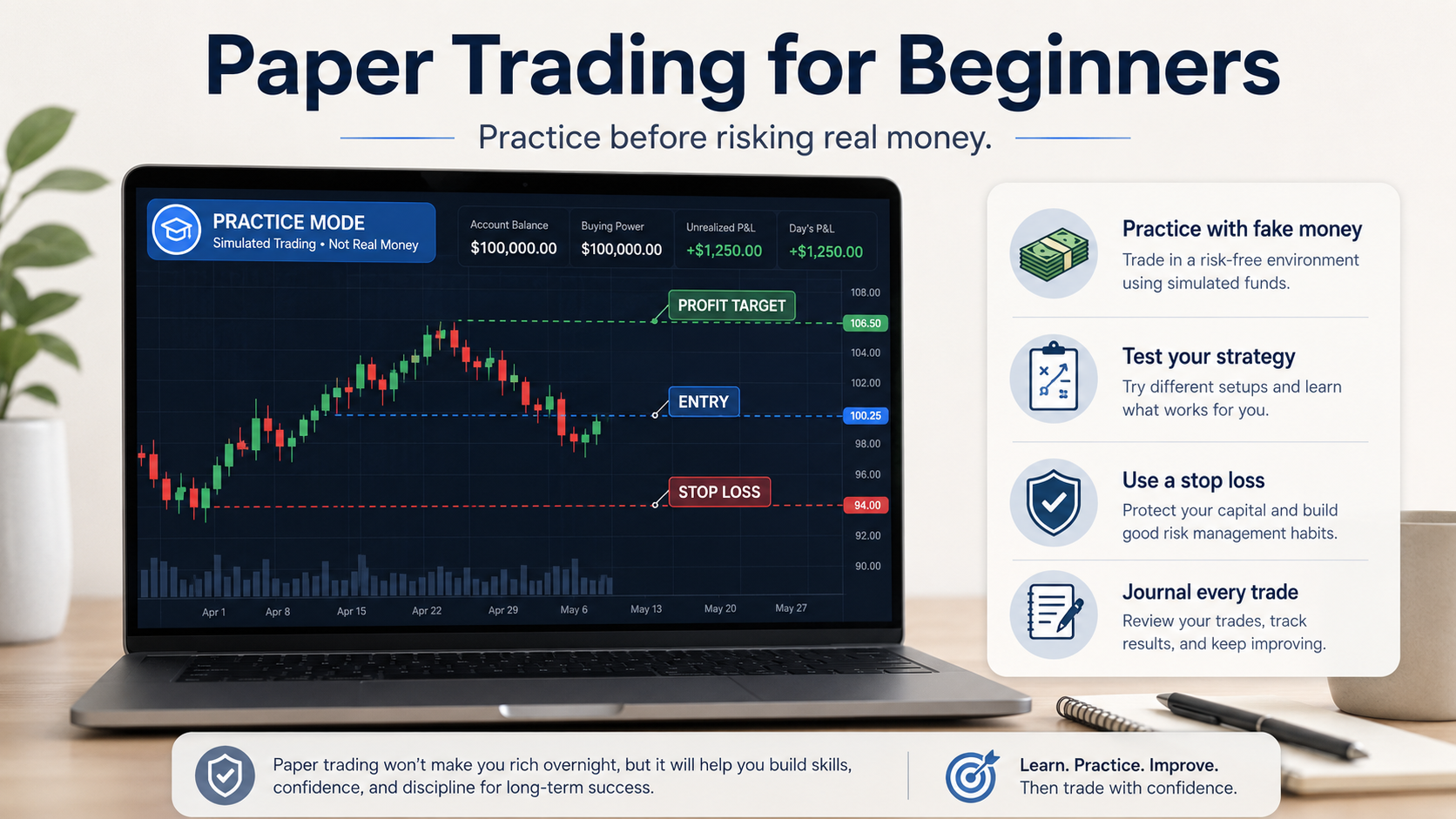 A simple paper trading example showing how beginners can practice trade planning before risking real money.
What Is Paper Trading?
For many new traders, paper trading for beginners creates a safer starting point because it lets them learn the process before dealing with real financial pressure.
Paper trading means practicing trades without using real money. Many platforms offer simulated accounts where beginners can place practice trades using fake money while watching real or delayed market prices.
The goal is not to pretend you are making real profits. The goal is to learn the process.
Paper trading can help you understand how orders work, how charts move, how quickly emotions show up, and how important it is to have a plan before entering a trade. For a beginner, this can be valuable because the market can feel confusing at first.
When you paper trade, you can practice:
- Reading a chart
- Planning an entry
- Setting a stop loss
- Choosing a profit target
- Managing risk
- Tracking trades in a journal
- Reviewing mistakes
- Building patience
The best part is that you can make beginner mistakes without risking a real trading account.
Why Paper Trading for Beginners Matters
Paper Trading for Beginners matters because most new traders are not ready to risk real money on day one. Many beginners are attracted to trading because they see the possibility of making money, but they may not fully understand the risk, speed, discipline, and emotional control required.
A beginner who skips practice may enter trades too quickly, risk too much, move stop losses, chase candles, or trade based on emotion instead of a plan. Paper trading gives you a safer place to slow down and learn.
The purpose of paper trading is to build skill before pressure. Live trading feels different because real money creates real emotions. However, paper trading still gives beginners a foundation. You can learn how your strategy behaves, what mistakes you repeat, and whether your trading plan is clear enough to follow.
Paper trading should be treated like training, not a game.
How to Start Paper Trading
To start paper trading, you need a platform that offers a simulated or demo trading account. Many trading platforms allow beginners to practice using fake money. The platform may include charts, order entry tools, watchlists, and trade history.
Before you start, keep the setup simple.
Pick one market or a small group of markets. Do not try to trade everything at once. For example, a beginner may decide to study one stock, one futures contract, or one major market index. The goal is to learn how that market moves instead of constantly jumping around.
Next, choose one simple strategy to practice. This could be a pullback strategy, breakout strategy, trend-following strategy, or support and resistance strategy. Do not keep switching strategies every few trades. If you change too often, you will not know what is actually working or what needs improvement.
Then set your basic rules:
- What time of day will you practice?
- What setup are you looking for?
- Where will you enter?
- Where will your stop loss go?
- Where will your profit target go?
- How many trades will you take per day?
- When will you stop trading?
A simple plan is better than no plan.
What to Practice in a Paper Trading Account
The first thing to practice is order placement. Learn the difference between market orders, limit orders, stop orders, and stop loss orders. Understand how your platform works before you trade live.
The second thing to practice is risk management. Every paper trade should have a planned stop loss and a planned target. Even though the money is not real, the habit should be real.
The third thing to practice is patience. Many beginners take too many trades because they feel like they always need to be doing something. Paper trading helps you practice waiting for your setup instead of forcing trades.
The fourth thing to practice is journaling. After each trade, write down why you entered, where your stop was, where your target was, and whether you followed your plan. Over time, your journal will show patterns in your behavior.
A beginner should use paper trading to answer questions like:
- Am I following my rules?
- Am I entering too early?
- Am I moving my stop loss?
- Am I taking trades out of boredom?
- Am I risking too much?
- Am I learning from my mistakes?
Paper Trading vs Live Trading
Paper trading and live trading are not the same. This is important for beginners to understand.
Paper trading can help you learn the mechanics of trading, but live trading adds emotion. When real money is involved, fear and greed can become stronger. A beginner may follow the plan perfectly in simulation but struggle once real money is on the line.
That does not mean paper trading is useless. It means you should understand its purpose.
Paper trading helps you build structure. Live trading tests your discipline under pressure.
In paper trading, you may feel calm because there is no real loss. In live trading, even a small loss can feel uncomfortable if you are not prepared. That is why beginners should practice first, then start small if they ever decide to trade live.
The goal is not to rush. The goal is to become consistent with your process.
Common Paper Trading Mistakes Beginners Make
Paper trading only helps if you treat it seriously. Many beginners make the mistake of trading fake money in a way they would never trade real money. The goal of paper trading for beginners is not to win every simulated trade, but to build better habits before live money is involved.
Common paper trading mistakes include:
- Using an unrealistic account size
- Taking too many trades
- Ignoring stop losses
- Resetting the account after losses
- Changing strategies too often
- Not keeping a journal
- Treating paper trading like a video game
- Practicing with position sizes that are too large
- Only focusing on winning trades
- Not reviewing losing trades
If you paper trade with bad habits, you may carry them into live trading.
A better approach is to paper trade the way you would want to trade with real money. Use realistic position sizes. Take realistic trades. Respect your stop loss. Follow your daily limits. Journal everything.
That is how paper trading for beginners becomes useful.
How Long Should You Paper Trade Before Going Live?
There is no perfect amount of time that fits every beginner. Some people need a few months. Others need longer. The better question is not, “How long should I paper trade?” The better question is, “Am I following my plan consistently?”
Before risking live money, a beginner should be able to show discipline in simulation.
You should be able to:
- Follow one strategy
- Use a stop loss
- Control position size
- Avoid revenge trading
- Keep a journal
- Review trades honestly
- Respect daily limits
- Stay patient when there is no setup
If you cannot follow rules with fake money, live money will likely make it harder.
A beginner should also understand that paper trading results do not guarantee live trading results. Simulated fills, emotions, market conditions, and execution may be different when trading live. Paper trading is practice, not proof of guaranteed success.
Simple Paper Trading Checklist
Before each paper trade, ask yourself:
- Do I know the setup?
- Do I know my entry?
- Do I know my stop loss?
- Do I know my target?
- Do I know my risk?
- Is this trade part of my plan?
- Am I calm?
- Am I chasing?
- Have I already taken too many trades today?
- Will I journal this trade after it is finished?
If the answer is unclear, wait.
Waiting is part of trading. Beginners often think trading means always being in a trade, but sometimes the best decision is to do nothing. Paper trading helps you practice that patience.
Helpful Practice Routine for Beginners
A simple paper trading routine can help you stay organized.
Before the session, review your market and mark important levels. Decide what kind of setup you are looking for. Write down your plan before you start trading.
During the session, only take trades that match your plan. Avoid random trades. Do not increase size just because you are using fake money. Focus on the quality of your decisions.
After the session, review your trades. Look at your entries, exits, stop losses, and emotions. Ask yourself whether you followed your rules.
A good practice routine is simple:
- Plan before trading
- Trade only your setup
- Manage risk
- Journal every trade
- Review your mistakes
- Improve one thing at a time
This is how beginners can turn paper trading into real practice.
Examples of Paper Trading Platforms Beginners Can Explore
Beginners have several platforms they can explore for simulated trading practice. The right choice depends on what market they want to study, how simple they want the platform to be, and whether they are practicing stocks, options, futures, or general chart reading.
TradingView offers paper trading that lets users practice without deposits or real money. This can be helpful for beginners who want to study charts and practice simulated trade ideas.
ThinkorSwim Paper Money by Charles Schwab is another simulated trading option. It allows users to practice on the thinkorswim platform without risking real money.
NinjaTrader also offers a simulation environment, including the Sim101 account, which can be useful for beginners who want to practice futures-style order entry and trade management.
Webull also offers paper trading for users who want to practice trading skills and strategies in a simulated environment.
These are only examples, not recommendations. Beginners should compare platforms carefully, understand the products they are practicing, check whether market data is real-time or delayed, and avoid treating simulated results as proof that live trading will be the same.
Final Thoughts
Paper trading for beginners is not about pretending to make money. It is about learning how to trade responsibly before risking real money.
A beginner should use paper trading to build discipline, test strategies, understand risk, and develop better habits. The goal is to slow down, practice with structure, and learn from mistakes without risking a real account.
Day trading involves risk, and not everyone will succeed. That is why education, patience, risk management, and practice matter.
Start simple. Pick one market. Practice one strategy. Use a stop loss. Keep a journal. Review your trades. Focus on becoming a better decision-maker before thinking about live trading.
Next Step: Learn how to use a trading journal to track your progress, review mistakes, and build better trading discipline.